The rise of the female CEO
The rise of the female CEO
New research from the Grant Thornton International Business Report (IBR) has revealed that while the overall proportion of women in senior business roles around the world has stalled, the proportion of female CEOs is on the rise. The research also shows a consistently high proportion of women in the role of CFO over the last few years, hinting at a link between the two, with more women making the well-travelled journey from running the finance department to running the company.
The IBR finds that globally, 12% of businesses are run by women, up from 10% in 2013 and just 5% in 2012. A regional breakdown of the figures reveals similar trajectories: in Europe, 17% of businesses now have female CEOs, up from 11% and 7% in preceding years. In Latin America there has been a similar rise from 5% to 10% to 17%. In Asia-Pacific (excl. Japan) and North America the trend is the same, if slightly slower. 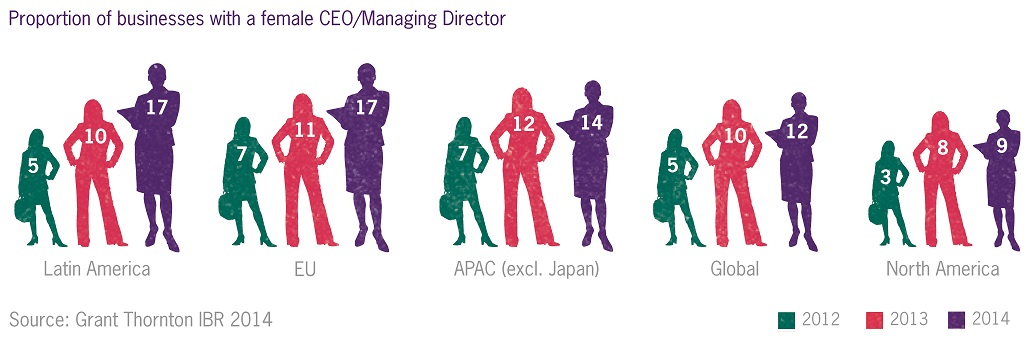
Francesca Lagerberg, global leader for tax services at Grant Thornton, commented:
“The rise of the female CEO is a remarkable success story and provides a nice counterbalance to what was otherwise pretty uninspiring news in terms of women breaking into senior management. It is welcome evidence that there is a way through up the corporate ladder and through the glass ceiling to the top of the business world.
“Almost a quarter of businesses globally have a female CFO. While still relatively low, running the finance department appears to be an important stretch role, which provides opportunity for greater exposure for women progressing towards the role of CEO. Considered alongside the strong public profiles of CEOs such as Meg Whitman, Indra Nooyi and Marissa Meyer – ironically, in part, because they are so few and far between perhaps – this perhaps explains the progress observed in recent years."
The IBR finds that globally, 23% of businesses have a female CFO – rising to a remarkable 63% in China – while a further 8% have a female corporate controller. Only the role of HR director (25%) is more likely to be held by a woman.
Francesca Lagerberg added: “The path from CFO to CEO is well-trodden – across all sorts of businesses we see finance heads eventually taking over at the top. The good news in terms of women's leadership is the relatively high proportion of women in senior finance roles which seems to be leading to more women taking the top jobs, albeit slowly. It's also good for business growth prospects: greater diversity leads to better decision-making.
“It’s a captivating prospect that the future could see more businesses showing how greater commercial success can come from unlocking the potential of all their people. Coming from an accountancy firm, it’s also good to see evidence that women in finance are doing so well."
– ends –
Notes to editors
The Grant Thornton International Business Report (IBR) provides insight into the views and expectations of more than 12,500 businesses per year across 45 economies. This unique survey draws upon 22 years of trend data for most European participants and 11 years for many non-European economies.
Data collection is managed by Grant Thornton’s core research partner, Experian. Questionnaires are translated into local languages with each participating country having the option to ask a small number of country specific questions in addition to the core questionnaire. Fieldwork is undertaken on a quarterly basis. The research is carried out primarily by telephone.
IBR is a survey of both listed and privately held businesses. The data for this release are drawn from interviews with 6,700 chief executive officers, managing directors, chairmen or other senior executives from all industry sectors conducted between November 2013 and February 2014. The 95% confidence level of individual economy data is ± 5%.
Director of Public Relations and External Affairs
T +1 312 602 8955
Dominic King, Research Manager, dominic.king@gti.gt.com, +44 (0)20 7391 9537